Rock Grouting in Tunnel Construction
Power Mining carries out all phases of rock construction work, including rock sealing by grouting.

Rock grouting is an essential part of safe and sustainable tunnel construction. It is used to reduce the permeability of the rock and improve its sealing properties. The goal is to prevent water from migrating through the rock structure, which extends the service life of the structure.
Well-grouted rock is efficient and safe to excavate. Grouting can also prevent the groundwater table from dropping as a result of excavation.
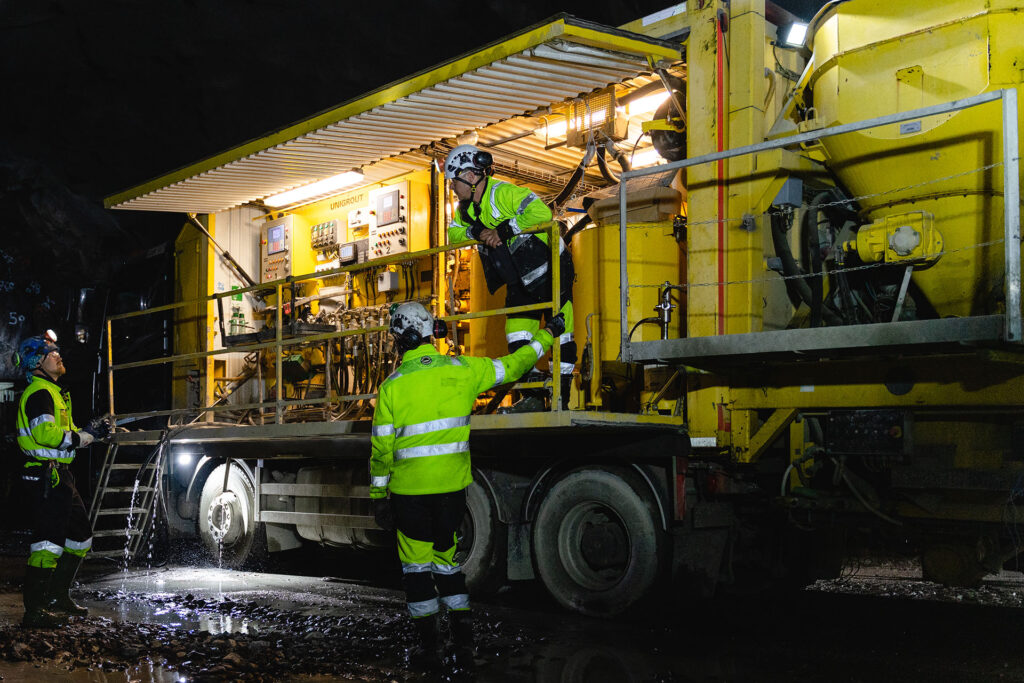
In the grouting process, grout is pumped under pressure into grouting holes drilled into the rock, filling cracks and fissures. Pumppauksessa säädelty injektointipaine varmistaa massan leviämisen suunnitelman mukaisesti. Useimmiten kThe most commonly used grouting materials are fine-grained grouting cement or various chemical grouting agents.
Different grouting methods and materials used
Depending on the site, we use different grouting methods and materials.
- Pre-grouting on rakenteen tiivistämisen kannalta tärkein vaihe, ja se tehdään aina ennen tunnelin louhintaa. Tavoitteena on tiivistää kallio haluttu metrimäärä eteenpäin, jotta rakoilusta ja veden virtaamisesta ei syntyisi ongelmia louhinnan jälkeen.
- Post-grouting voidaan lisätä kallion tiiviyttä halutuilla alueilla. Sitä tehdään yleensä, jos halutaan tiivistää yksittäisiä vuotovesikohtia louhinnan jälkeen.
- The primary grouting material is almost always a fine-grained grouting cement mix.However, grouting can also be performed with chemical agents. This is commonly referred to as chemical grouting, jossa käytettävä aine on hartsipohjainen. Tämä menetelmä soveltuu erityisesti pieniin rakoihin ja nopeaa kovettumista vaativiin kohteisiin, joihin sementtipohjainen injektointiaine ei sovellu.
Check out our reference projects
Power Mining covers every phase of rock construction – check out our reference projects via the link.
Want to know more?
Contact our rock construction professionals to request further details about our services.


Services

Mining
At infrastructure and mining sites, we work in tunnels ranging from large tunnel profiles to small widening/roof-raising projects, as well as production mining. Shaft sinking based on the longhole or Alimak method.
We have solid expertise and equipment for tunnel excavation. We have several years of experience in using electronic detonators on a daily basis in vibration-sensitive areas.
Our personnel have a long pedigree in shaft excavation for mining and infrastructure projects. We take an innovative approach to digging shafts in challenging locations.
Includes hydraulic splitting on difficult sites.

Rock reinforcement
Infrastructure projects: full range of rock reinforcement and shotcreting, using a shotcrete robot, rockbolting, wire-mesh reinforcement. We also do manual drilling, wire-mesh reinforcement, and shotcreting on small sites.
Mining sites with our own machinery: cable bolting, wire-mesh reinforcement and all types of rockbolting.

Scaling
In infrastructure and mining projects, we handle scaling both mechanically and manually.
The method is chosen based on the requirements of each site: final surfaces and areas to be reinforced typically require manual scaling to achieve the best result.
A safe working environment is ensured by thoroughly removing loose rocks and boulders before proceeding to the next stages.Mucking
In tunnel construction, we handle mucking using excavators or wheel loaders, collecting and transporting the blasted rock for further haulage.
Efficient mucking keeps the project on schedule, as it is typically the most time-consuming phase of the excavation cycle. The service is delivered as part of our full-service offering, integrating all stages of tunnel construction into one seamless package.
Grouting
Rock grouting is an essential part of safe and sustainable tunnel construction. It is used to reduce the permeability of the rock and improve its sealing properties. The goal is to prevent water migration within the rock mass, which extends the service life of the structure.